
Abstract
Context: Nowadays, mobile applications (or apps) have become vital in our daily life, particularly within education. Many institutions increasingly rely on mobile apps to provide access to all their students. However, many education mobile apps remain inaccessible to users with disabilities who need to utilize accessibility features like talkback or screen reader features. Accessibility features have to be considered in mobile apps to foster equity and inclusion in the educational environment allowing to use of such apps without limitations. Gaps in the accessibility to educational systems persist.
Objective: In this paper, we focus on the accessibility of the Black- board mobile app, which is one of the most common Learning Management Systems (LMS) used by many universities, especially during the current COVID-19 pandemic.
Method: This study is divided into two-fold. First, we conduct a survey using questionnaires and interviews to explore the extent to which students consider the Blackboard mobile app usability. A Total of 1,308 hearing students and 65 deaf and hard-of-hearing students participated in the study. Second, we collected 15,478 user reviews from the Google Play Store and analyzed the reviews to extract accessibility issues.
Result: We observed that most deaf and hard-of-hearing students found difficulty in the Blackboard mobile app, compared to hearing students. Also, our app store analysis showed that only 31% of the reviews reported violations of accessibility principles that apps like Blackboard must comply with. This study highlights these violations and their corresponding implications to support LMS frameworks in becoming more inclusive for all users.
Research Questions
RQ1: To what extent do students find the Blackboard mobile application easy-to-use?
This research question discovers the extent to which students are able to use the Blackboard application. To do so, we performed a large-scale survey with 1,373 students and 65 deaf and Harding of hearing students. This 5-questions survey targets the general usability of blackboard, especially when being the main learning medium, given that most universities are currently offering online courses due to the COVID-19 pandemic. We also conducted follow- up interviews with 8 students to reflect on the findings of the survey.
RQ2: What accessibility issues are reported by the users of Blackboard app?
Since the findings of our previous research question cannot be generalized, we also decided to explore user reviews for further analysis. To address this research question, we crawled and an- alyzed 15,478 user reviews publicly posted by Blackboard users on the Google Play Store. We used quantitative and qualitative procedures to filter out these reviews and extract only accessibility- related ones. Our findings will inform app developers of the most common accessibility issues so that they can be resolved in current and future applications. Also, our curated set of reviews is available, as part of our replication package, for reproducibility and extension purposes.
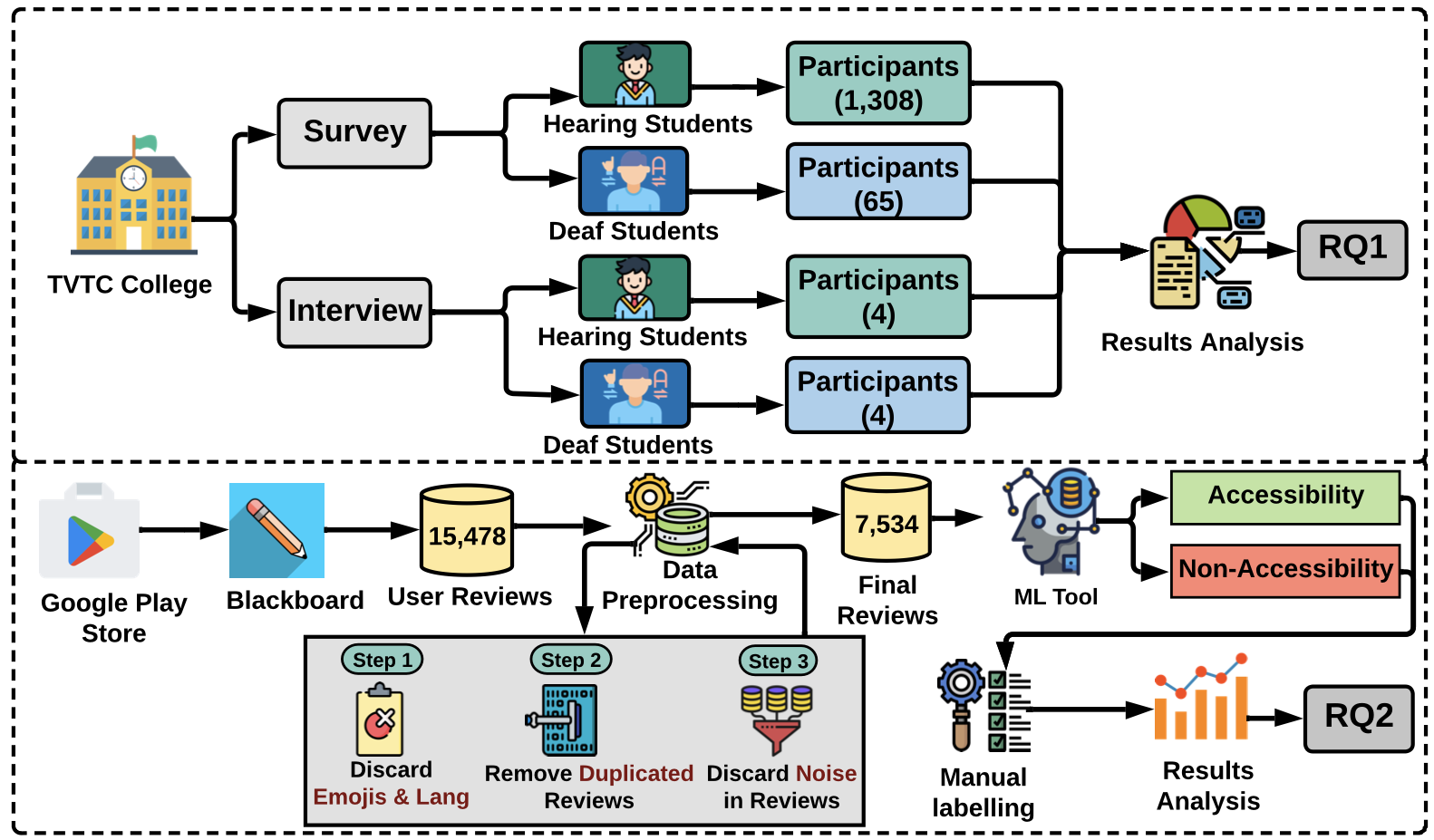
Approach Overview.
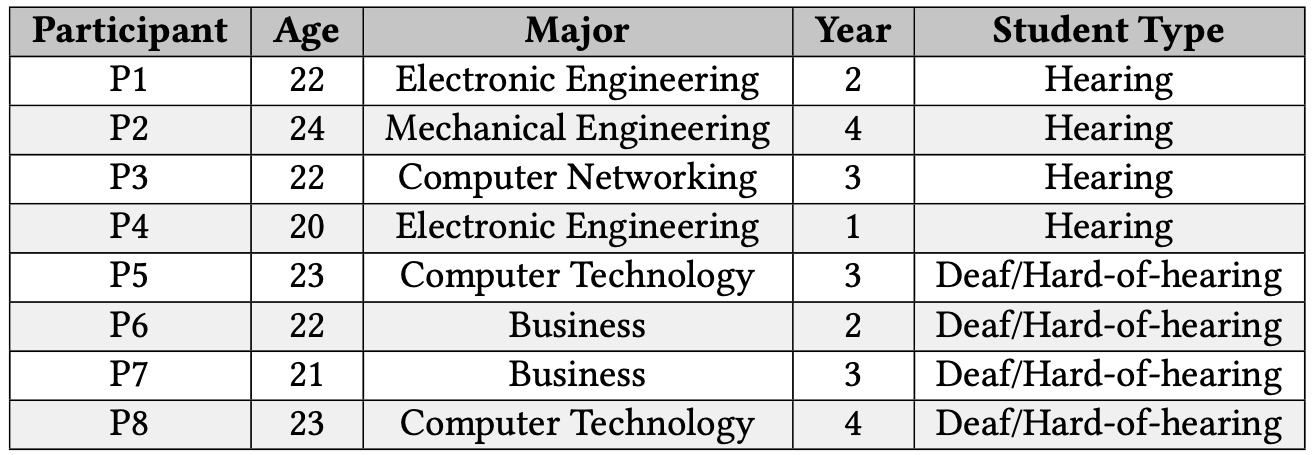
Table 2: Participants demographics information. Each partic- ipant (P#) answered the interview questions.
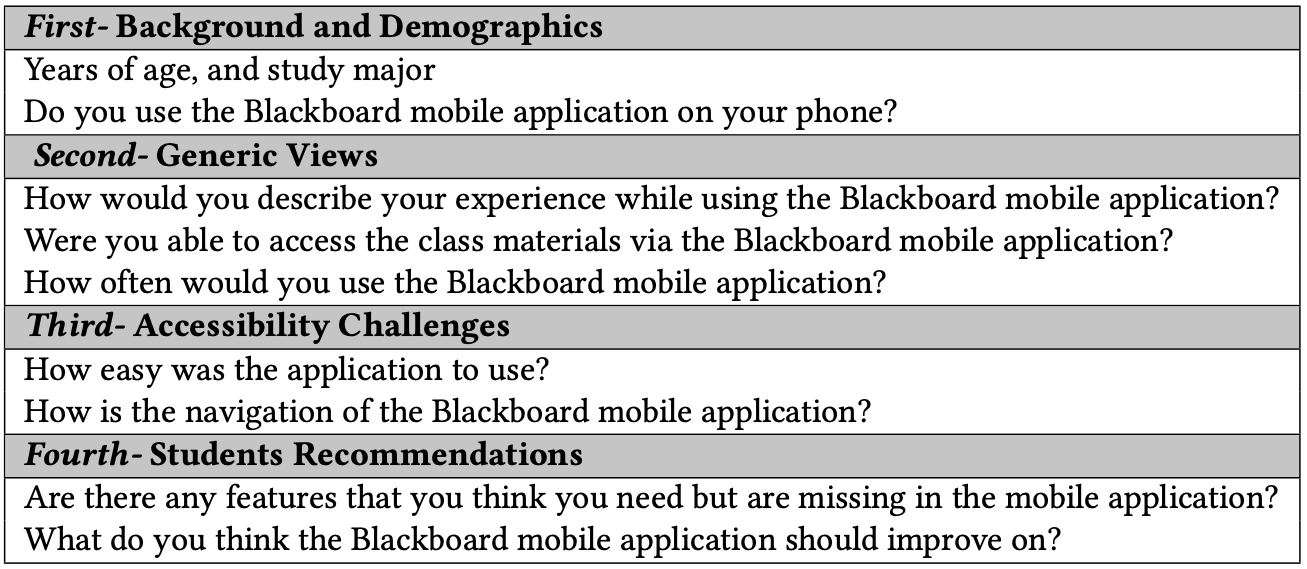
Table 3: Set of interviews questions.
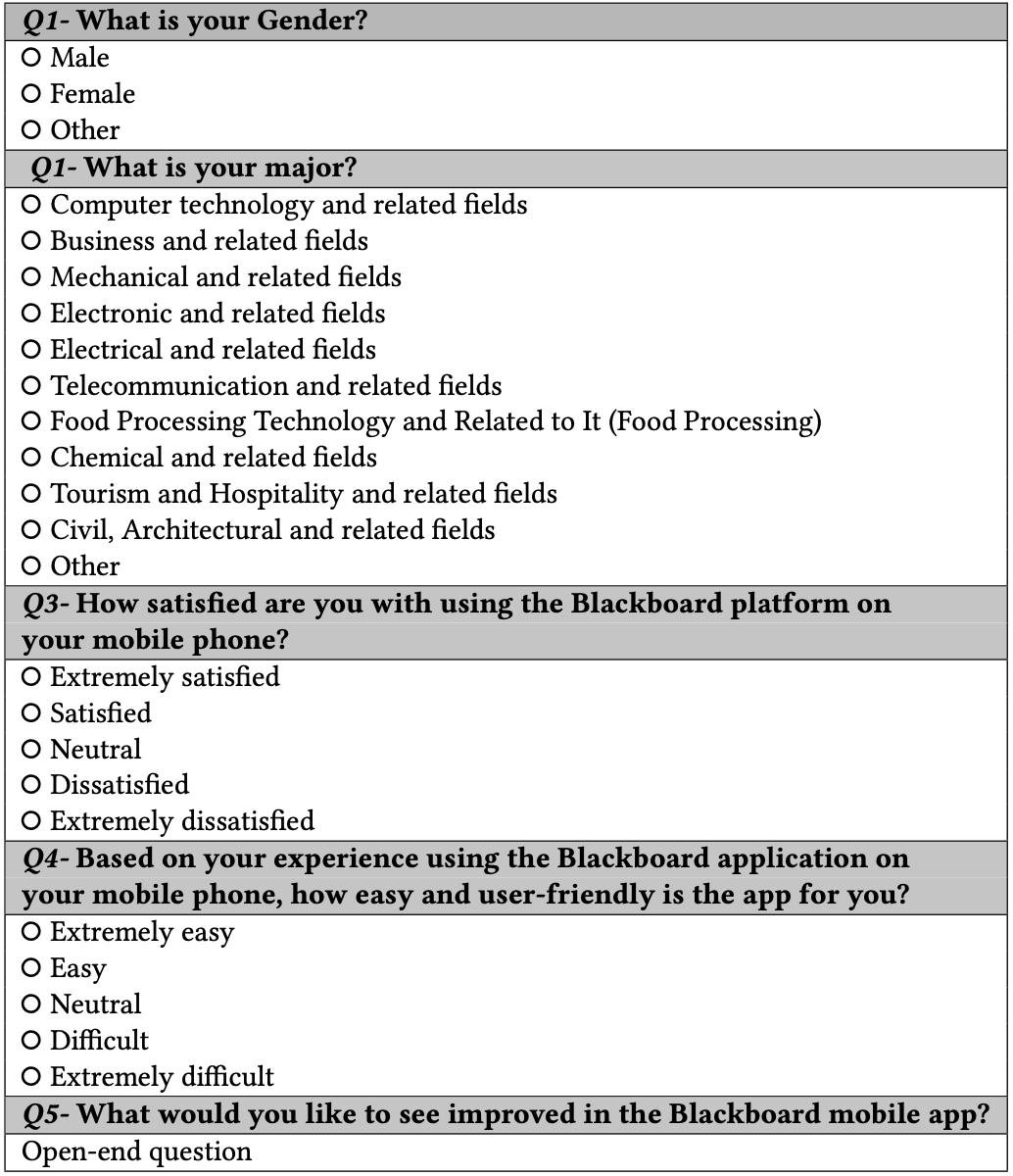
Table 4: Set of survey questions.
Study Dataset